
Press Release
Development of a BIM and VR-Based Noise and Vibration Impact Simulator for Deep Excavation Blasting
- NameKICT
- Date2024/12/18 00:00
- Hit1384
Development of a BIM and VR-Based Noise and Vibration Impact Simulator for Deep Excavation Blasting
- Successful Advancement of Urban Underground Transportation Infrastructure Construction Technology -
Korea Institute of Civil Engineering and Building Technology (KICT, President Sun Kyu, Park) announced that it has developed the nation's first BIM (Building Information Modeling) and VR (Virtual Reality) based noise and vibration impact simulator for deep excavation blasting, aimed at expanding underground transportation infrastructure that citizens can use safely and comfortably.
In major cities such as Seoul and the metropolitan area, the development of underground transportation infrastructure, including underground roads and railways (subways, GTX, etc.), is continuously increasing. Recently, large-scale transportation infrastructure construction projects utilizing urban underground spaces, such as the undergrounding of surface railways or underground expressway projects, have been promoted.
Ensuring construction safety and infrastructure stability is crucial during the construction and operation of underground transportation infrastructure. As public interest in deep excavation construction projects increases, concerns about issues such as ground subsidence (sinkholes), blasting vibrations, and noise are also growing. Therefore, it is necessary to establish a scientific and preventive safety management system while minimizing the impact on the surrounding environment.
Noise and vibrations, which are inevitably generated during the construction of underground transportation infrastructure facilities, must be blocked in advance. Both domestically and internationally, efforts are being made to minimize complaints through optimized noise and vibration design before construction. However, from the perspective of residents, various complaints are raised due to anxiety about deep excavation work being carried out underground in their residential areas, where they cannot feel the impact of noise and vibrations.
For example, in the case of the Busan Inner Loop (Mandeok-Centum) urban expressway construction, there were about 170 noise damage complaints related to deep excavation construction received in Dongnae-gu and Buk-gu, Busan, over approximately three years from 2020 to 2022. To address this, KICT, as the lead institution of the ‘Urban Underground Transportation Infrastructure Construction Research Group,' has realized the advancement of urban underground transportation infrastructure construction technology that can ensure safe underground excavation and alleviate citizens' anxiety.
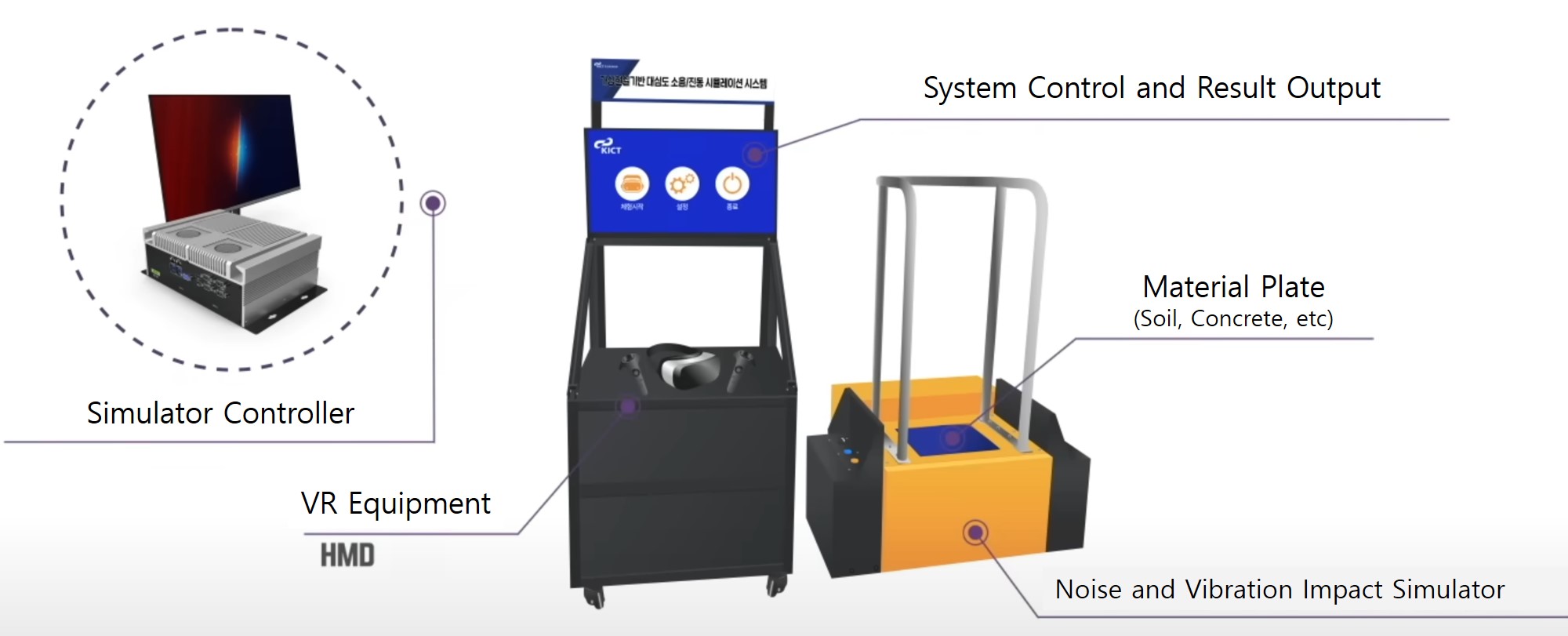
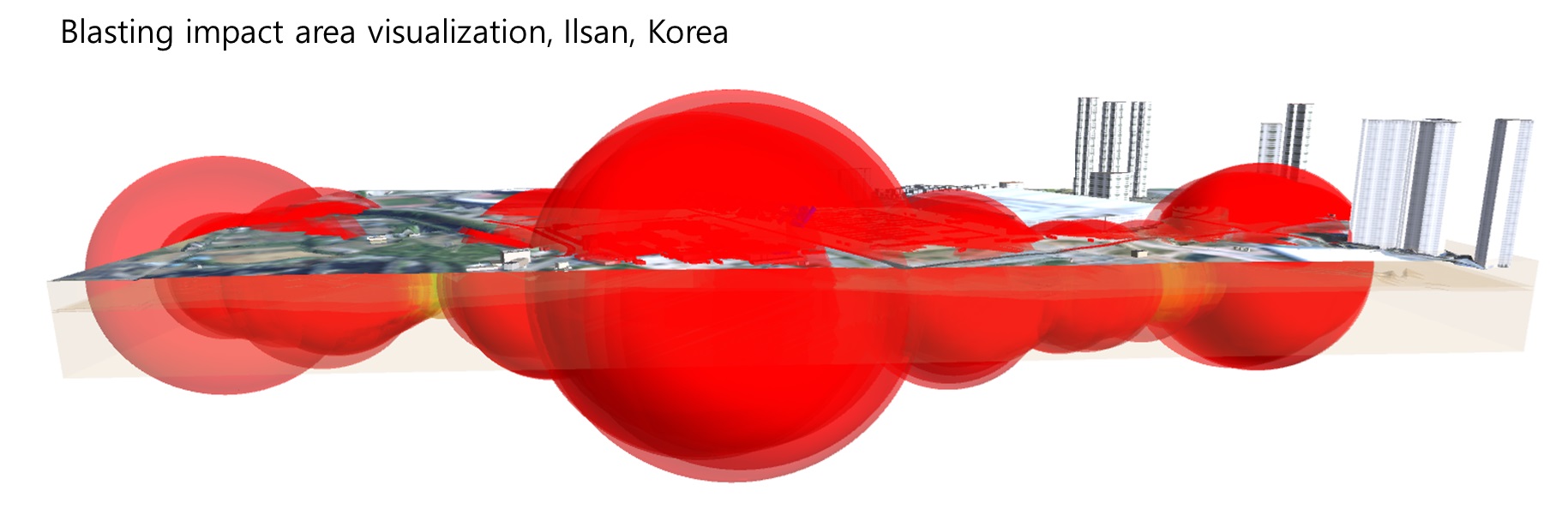
The research team has developed the nation's first BIM based noise/vibration simulation visualization technology and a VR based vibration and noise experience simulator. This technology visualizes noise and vibration caused by deep excavation blasting using BIM, providing analysis results such as the impact range of blasting. Additionally, the simulator, which uses VR technology and sound wave-based vibration technology, allows stakeholders, including residents near construction sites, to experience the noise and vibration of the construction site in advance. Furthermore, it enables the experience of various noises and vibrations occurring at construction sites, beyond those caused by underground blasting. Therefore, the developed technology can contribute to explaining blasting noise and vibration-related construction methods and complaint factors to citizens easily and alleviating their anxiety. The accuracy of the developed vibration and noise experience simulator (measured data value - simulator input value) has been certified by the Telecommunications Technology Association (TTA), a national accredited institution and ICT specialized testing and certification body, completing objective performance, function, and quality verification. Additionally, two key patents related to the noise and vibration simulator have been transferred to private companies aiming for commercialization. The developed simulator is actively used to enhance the understanding of deep excavation construction through pre-experience of noise and vibration by complainants.
Dr. MyoungBae Seo stated, "The developed technology is a solution to preemptively address complaints that may arise during the construction of urban underground transportation infrastructure (roads, railways, logistics, etc.)." He added, "It is expected to be actively utilized in the development projects of underground roads and railways (subways, GTX, etc.) in major cities around Seoul and the metropolitan area, which are anticipated to continue in the future, contributing to the safety and peace of mind of the public.
Dr. Changyong Kim, the head of the research team, stated, “In addition to this, various other research outcomes have been verified for practical application through Memorandums of Agreement (MOA) with GS Engineering & Construction Corporation, Daewoo Engineering & Construction Co., Ltd., and Hyundai Engineering & Construction Co., Ltd., targeting ongoing underground road and GTX sites. We will continue to expand the applicability of these outcomes to underground transportation infrastructure development projects, such as the recent underground expressway and railway undergrounding projects.”
###
Korea Institute of Civil Engineering and Building Technology, a government-funded research institute with 41 years of extensive research experience, is at the forefront of solving national issues that are directly related to the quality of the people’s life.
This research outcome was developed with the support of the Ministry of Land, Infrastructure and Transport's National Land and Transport Research and Development Project (specialized agency: Korea Agency for Infrastructure Technology Advancement) through the project ‘Research of Advanced Technology for Construction and Operation of Underground Transportation Infrastructure (April 2020 - June 2024).’ The research team included 18 institutions (16 joint and 2 subcontracted), including KICT as the lead institution, Konkuk University, Hanyang University, EPS Engineering Co., Ltd., and U&People Co., Ltd.