Zero-Energy Buildings-Hope for Carbon Neutrality by 2050
▲ Research Fellow Yu Ki-hyung, Department of Building Energy Research (Zero-Energy Building Research Team), KICT
In 2020, zero-energy building mandates were initiated for public buildings in Korea. By 2025, all new public buildings must meet zero-energy building standards, and from 2030, all buildings with a scale of 500㎡ or more must be constructed as zero-energy buildings. Projections indicate that the zero-energy building penetration rate in Korea will exceed 20% by 2030. In response, the Zero Energy Building Research Team of the Department of Building Energy Research at the Korea Institute of Civil Engineering and Building Technology (KICT) is leading policy and technology development to realize a world-class carbon-neutral circular economy.
Zero-Energy Buildings for Realizing Zero Energy
Zero-energy buildings aim to minimize energy consumption and fulfill their energy requirements through renewable sources, bringing their total energy consumption close to "zero" and reducing net carbon emissions. Considered the most efficient solution in the construction sector for achieving the goal of carbon neutrality by 2050, these buildings are designed to minimize external energy through their structural and placement characteristics. High-performance insulation is used in walls, roofs, and floors to prevent heat loss in winter and heat ingress in summer. Windows are strategically positioned facing south to maximize winter sunlight while creating shade to block excessive summer heat. Such design considerations for natural lighting, ventilation, and building orientation can reduce energy usage and operational costs.
The Zero Energy Building Research Team is responsible for developing technologies and policies for zero-energy buildings. They developed the building energy efficiency grade certification system and evaluation tools implemented in 2001, with over 30,000 buildings now certified under this system. Additionally, they created a building total energy consumption volume assessment program and zero-energy building certification & evaluation programs, laying the foundation for use in current building permits and the groundwork for eco-friendly urban development.
Currently designated by the Ministry of Land, Infrastructure and Transport as the Zero-Energy Building Support Center, the team is conducting research to advance element technology evaluation methods. Recently, they proposed a declaration and grading system and a total volume system for greenhouse gas emissions, in line with the Ministry of Trade, Industry and Energy's building energy source unit target management regulations. Seoul is currently engaged in a pilot project of building energy declaration, grading, and total volume systems, with the research team supporting the development of evaluation methods and input systems. This year, more than 1,000 buildings are voluntarily participating in building energy source unit target management, and it is predicted approximately 15,000 buildings will be participating by 2026. In this way, the dream of carbon neutrality by 2050 is gradually becoming a reality.
The Power of Effective Policies and Corresponding Technologies
The research team is not limiting its zero-energy building implementation to new constructions. Recognizing that existing buildings typically have significantly higher carbon emissions than new buildings, the team has been exploring conversion strategies. The primary challenges involved in converting existing buildings include construction costs and the complexities of installation. Renewable energy equipment is more expensive and has limited installation options compared to fossil fuel systems. Solar photovoltaic panels, the most common renewable energy source, require extensive installation space and are particularly challenging to implement in high-rise buildings with limited sunlight access.
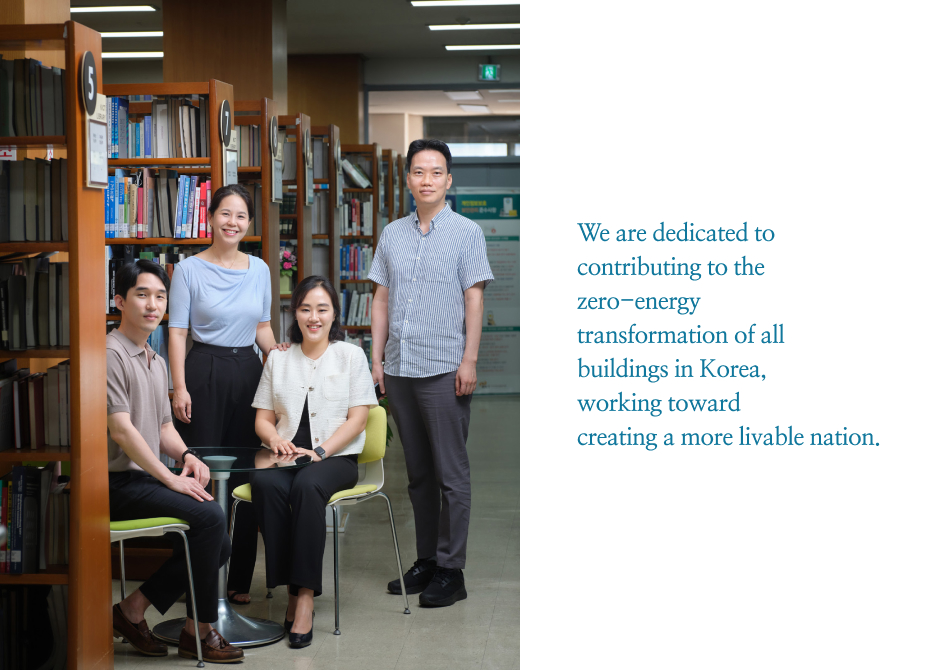
Members of the research team commented that technological development must be accompanied by supportive policies, particularly those that facilitate installation space support for efficient conversion. The team aims to develop policies that encourage energy efficiency and ultimately reduce carbon emissions through zero-energy building transformations. Carbon neutrality by 2050 fundamentally requires an actual reduction in carbon emissions. It is predicted by researchers that zero-energy buildings will reduce building-related carbon emissions by up to 80-90%. The KICT's Department of Building Energy Research continues to move forward, step by step, in building a better future city.