Construction of Electronic Roads for Carbon Neutrality by 2050
▲ Senior Research Fellow, Baik Nam-cheol, Department of Highway &Transportation Research, KICT
Carbon Reduction Is Key to Our Survival
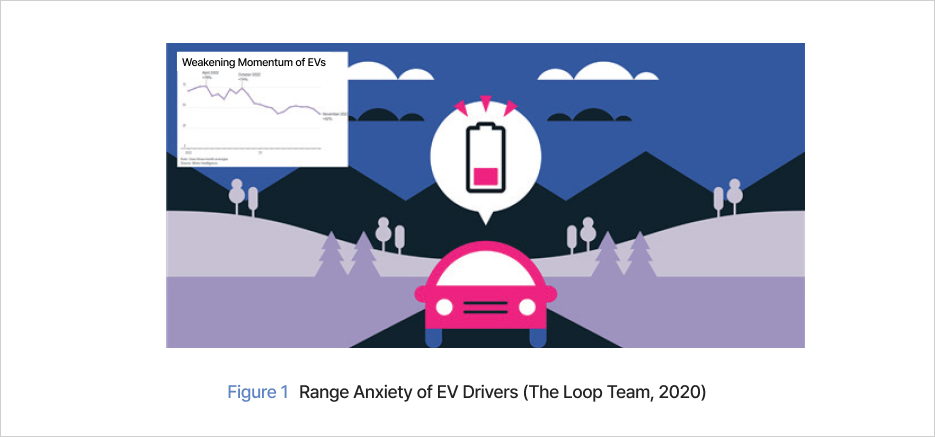
What will be the most significant change we see in urban life 30 years from now? The transportation and energy sectors are expected to undergo major transformations. Electrification of transportation is being pursued rapidly, with one example being the goal of supplying 4.5 million electric and hydrogen vehicles by 2030. In the long term, a prerequisite for carbon-neutral electrification is securing the transparency of carbon emissions information throughout the lifecycle without greenhushing.(*1) Electrification of internal combustion engine vehicles is not the ultimate goal, but merely a starting point. Electric vehicles will become a carbon-neutral alternative only when the entire power source supplied to them is carbon-neutral. The short-term challenge to overcome is the emerging chasm,(*2) in which the upward momentum of EV popularization is weakening, leading to a sharp slowdown in demand. Major reasons for decreased demand include concerns over short driving ranges post-charging and limited charging infrastructure, collectively known as "range anxiety" over battery capacity. Range anxiety is exacerbated by a number of factors, such as the use of air conditioning and heating in EVs, an increased service life, and a lack of charging infrastructure. This article aims to introduce the concept of electronic road technology, which can alleviate range anxiety, and examine its necessity. To this end, a review was made first on national plans related to EVs and mobility-friendly infrastructure. Next, a survey was conducted. The survey involved interviews and online surveys with 50 experts in the field of road and transportation infrastructure construction. In addition, face-to-face surveys of 50 professionals who participated in the 2023 ITS Conference were performed. The survey period was from November 13 to November 30, 2023.
Literature Review
An examination was carried out of plans related to charging infrastructure to address the range anxiety of EV drivers. Specifically, the Comprehensive Smart City Plan, transportation infrastructure plans, and national plans for power grids were reviewed.
1. Urban Sector: The 4th Comprehensive Smart City Plan (Proposed, Jan. 25, 2024)
Our review of the proposed 4th Comprehensive Smart City Plan found the EV charging infrastructure sector appears to be somewhat lacking. The deficiencies can be supplemented from the perspectives of physical space, digital data and charging service. First, the electricity used in EVs should be carbon-free (CF100). Second, data that substantiates the transition of transportation modes from internal combustion engines to e-mobility should be collected and converted into carbon credits. Third, a plan for electric roads (electric roads) connecting cities and regions is needed. The smart city concept alone is not enough, as the power grid can be disrupted due to local complaints. The concept of a smart region that integrates cities and regions into a single vast infrastructure community is necessary. To address the range anxiety of electric vehicle drivers, residents should be able to access linear charging services along the roads, to transcend regional boundaries.
2. Transportation Sector: Related Infrastructure Plans
(1) The 2nd Comprehensive Plan for the National Road Network (2021-2030): 10x10, 6R2
In the 2nd Comprehensive Plan for the National Road Network, mobility-friendly infrastructure, including EV charging facilities, will also be established. The 10x10 6R2 national road network will be connected to the existing arterial road network (totaling 31,686 km of highways, national roads, regional roads, and provincial roads). To accomplish this, an annual national budget of approximately KRW 7 trillion is expected to be invested. If the charging infrastructure for EVs is constructed while simultaneously building the road network, significant cost savings can be anticipated.
(2) The 4th National Railway Network Construction Plan (2021-2030)
The focus of transportation policy is shifting from roads to railways. The plan is to double the railway network by 2030. The 4th National Railway Network Construction Plan has confirmed projects with a combined length of 1,448 km (KRW 5.87 trillion). A carbon-free power supply plan combined with a double-track railway network and EV charging station services at railway stations are needed.
3. Power Sector: The 10th Long-term Transmission and Substation Facility Plan (2022-2036)
Recently, the 10th Long-term Transmission and Substation Facility Plan was announced, with the goal of ensuring national energy security. The plan includes systematizing the power grid into trunk and branch lines, similar to highways. High-voltage direct current (HVDC) transmission lines were proposed, to secure stable power sources. HVDC is intended to transmit carbon-free electricity from offshore wind farms on the West Coast to the Seoul metropolitan area. It is necessary to establish a test bed for installing HVDC under urban roads, and constructing electric roads.
4. Implications from Related Plans
There is a lack of an SOC construction plan that encompasses smart city plans, transportation infrastructure plans, and national power grid plans. Significant cost savings could be achieved by constructing the power grid simultaneously when building smart cities and transportation infrastructure. First, the "direct current power grid (HVDC)" from the 10th Long-term Transmission and Substation Facility Plan can be buried underground, allowing it to be constructed in parallel with national arterial road and railway network projects. Underground installation may incur initial costs for concrete structures, but is expected to result in substantial cost savings and enhance national competitiveness over the entire life cycle. Moreover, and most importantly, it enables the efficient transmission and distribution of renewable energy to EV charging stations. For this reason, the US Department of Transportation is conducting research and development on burying direct current power grids (HVDC) under roads to accelerate the era of widespread EV adoption. In South Korea also, it is possible to link and combine a DC power grid that brings carbon-free energy from offshore wind to the city and the 10x10 national arterial road expansion plan. Second, the construction of the national power grid and national arterial road network has been delayed due to local opposition. By combining the power grid project with the road network project, the delays caused by pursuing multiple individual power grid projects can be avoided. The social costs and stagnation of industrial advancement resulting from the untimely connection of the power grid to the Seoul metropolitan area should be resolved. The capacity for both transportation and carbon-free power transmission and distribution should be increased simultaneously to foster EVs as a future growth engine. By enhancing the 4th Comprehensive Smart City Plan, which has the concept of a smart green region, and converging the "2nd Comprehensive Plan for National Road Network" with the "10th Long-term Transmission and Substation Facility Plan," EVs can continue to be nurtured as a future growth engine. Additionally, individual construction costs for roads and power grids can be reduced, while resolving various civil complaints. Third, by connecting road and railway projects connecting cities and regions as a "platform" and collecting and certifying user data through monitoring, reporting, and verification (MRV), carbon-neutral credits can be secured for option projects compared to base projects. Starting in 2026, if South Korean companies want to export products to Europe, they will need to purchase credits, an arrangement corresponding to a carbon tax. It would benefit both companies and the nation to purchase credits generated in South Korea. Voluntary carbon credits can be obtained from infrastructure projects, which receive an annual government budget of approximately KRW 14 trillion in South Korea.
Analysis of Alternatives
1. Future 10x10, 6R2-based Mobility Infrastructure Technology
Ways to establish mobility-friendly infrastructure utilizing the 10x10 and 6R2 plans were examined. First, a preliminary survey of experts was conducted to identify the types of mobility-friendly infrastructure technologies. The suggested technologies included micro-mobility dedicated roads, EV charging infrastructure, hydrogen vehicle charging infrastructure, roads that mitigate fine dust, and carbon-capturing green roads. In the second survey, respondents were asked about the most urgent needs to be addressed in the very short term (within 3 years) for decarbonizing the road transportation sector. For decarbonization (CO2 emissions reduction), 46.7% of respondents indicated that the most urgent need in the very short term is the development of EV charging infrastructure technology.
2. Examination of Alternatives for EV Charging Infrastructure Construction
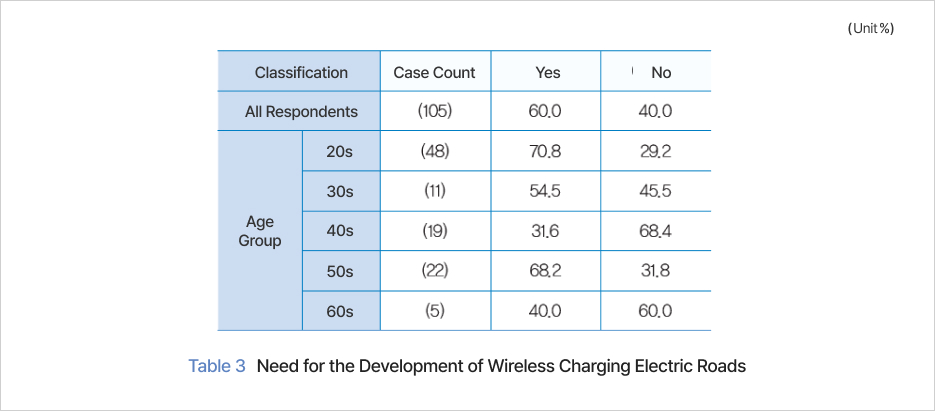
The preliminary survey identified the limitations of establishing electric vehicle charging infrastructure. The method used to reduce charging time while increasing the driving range of EVs is to reduce the weight of the battery. To achieve this, charging facilities need to be buried under the road. This involves converging the road construction industry, power industry, EV industry, and transportation operation and management projects. In the second survey, when asked if the development of "wireless charging roads" as a road infrastructure technology that addresses the barriers to widespread EV adoption– specifically, "lack of charging infrastructure and limited battery life"– could be a game changer, 60.0% of respondents said that the development of wireless charging roads is necessary.
Alternative Evaluation
1. Fast chargers at existing gas stations: Point service-type charging infrastructure
Point service type refers to operating an EV charging infrastructure centered on electric vehicle traffic. In South Korea, there are about 25 million registered vehicles (as of 2022), of which about 20 million are registered passenger cars. As of 2023, there are about 470,000 EVs nationwide and 240,000 EV chargers. Of these, 25,000 are fast chargers and 215,000 are slow chargers. The government has decided to have a total of 4.2 million EVs and 1.23 million chargers supplied and installed by 2030 in accordance with the national greenhouse gas (GHG) reduction target for the transportation sector. By 2030, 145,000 fast chargers (50-100 kW, 30-60 minutes) and 1.085 million slow chargers (less than 40 kW, 4-8 hours) need to be supplied and installed. Super-fast chargers (exceeding 100 kW, within 30 minutes) are being installed solely by private operators. For point service-type charging infrastructure, super-fast charging is needed at highway rest areas. One super-fast charger (supercharger of 350 kWh or equivalent) is required for every 100 vehicles using the highway. If 20 million vehicles are in operation, 200,000 superchargers would be needed. If each charger costs KRW 100 million, an amount of around KRW 20 trillion would be required. Here, the fast-charging station (so-called supercharger) is assumed to be 120 kW, and the cost is based on about KRW 800,000 per kilowatt of charging capacity, as proposed by Lund University in Sweden. For point service, electric vehicles should be equipped with an 80-kWh battery, and have more tire wear and road pavement damage compared to linear service, resulting in increased costs for the public, and for companies. The battery capacity is calculated based on 80 kWh for a pure electric vehicle, which is produced by LG Energy Solution, as of 2024. If a point service-type charging infrastructure is built, EVs will require an 80-kWh battery capacity. If a linear service-type charging infrastructure– in other words, a wireless charging road-based charging infrastructure– is built, a 20-kWh capacity would be sufficient for EVs. According to Goldman Sachs' 2025 EV battery price forecast, the price is predicted to be around KRW 100,000 per kWh.
2. Construction of Electric Roads: Electrification of the National Arterial Road Network
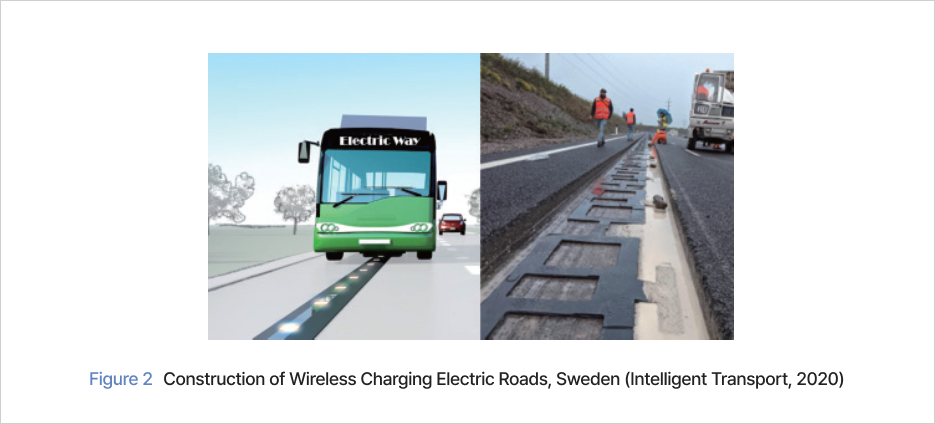
Electric roads are roads in which wireless chargers are embedded into the road’s surface. In other words, it means electrifying the national arterial road network along with EVs. The national arterial road network (currently about 31,200 km as of 2022) will be reorganized into 10 north-south axes and 10 east-west axes. Road resurfacing projects for the arterial road network are typically conducted once every 10 years. Electric roads enable EVs to travel farther and longer while reducing the weight of the EV battery by 1/5. The goal of the national arterial road network is to enable access to the arterial road network within 30 minutes from anywhere in the country. If the national arterial road network is developed into electric roads, EVs will only need to be equipped with batteries that can last for 30 minutes or more. As the weight of vehicles decreases, road maintenance costs can be reduced, and carbon emissions can be mitigated. In the future national arterial road network, mobility electrification services, such as wireless charging-enabled dedicated bus lanes, autonomous driving-dedicated cargo truck lanes, and other mobility electrification services, will rapidly expand, centered around electrification. The construction of electric roads that enable smaller and lighter EV batteries can become a new engine for achieving carbon neutrality by 2050.
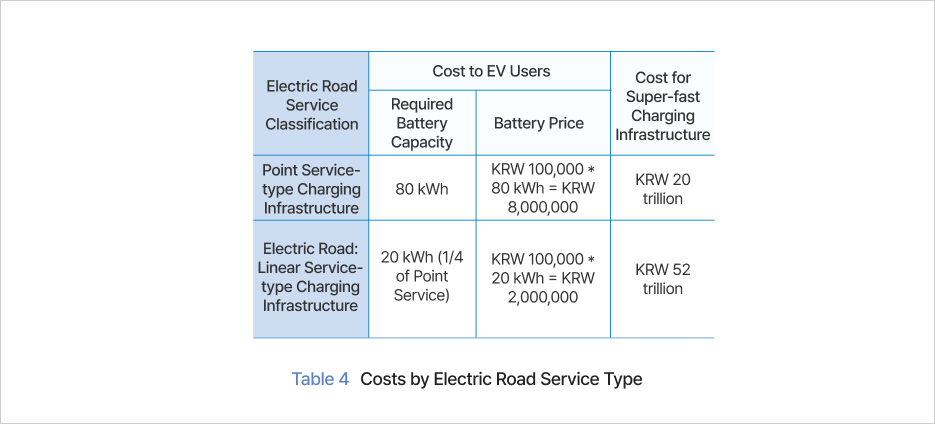
Electric roads are estimated to cost approximately KRW 1.3 billion per lane-km. To install them in both directions along approximately 20,000 km (the total length of highways and national roads) in South Korea, the total cost would be KRW 52 trillion. However, a wireless charging road test study conducted in the United States in 2022 found that the cost of installing a 1.6 km stretch was approximately KRW 17 billion. This amount includes the cost of the high-priced wireless chargers installed in the test vehicles, various test equipment, power grid supply, making of test vehicles, and research and development expenses. Electric roads enable periodic charging while driving, so EVs can operate with batteries with only 1/4 the capacity compared to point service charging.
Nations and Citizens with Electric Roads
To enable the wide spread of EVs, range anxiety should be addressed. The fundamental solution is electric roads, which enable automatic wireless charging while the electric vehicle is in motion. What would electrification without electric roads look like? First, the authorities would have to install a large number of fast chargers at every highway rest area. Citizens would prefer vehicles with larger battery capacities to enable long-distance driving. As a result, road pavement would suffer more damage, leading to significantly increased social costs from increased tax spending on road repairs and accumulated spent batteries. On the other hand, in nations with electric roads, the public would be able to own cheaper and lighter electric vehicles. This is because the required electric vehicle battery capacity would be reduced to 25% or less compared to when electric roads are not available. Roads would experience less damage, and the volume of spent batteries would be reduced accordingly. In this early stage of introducing EVs, it is reasonable to introduce high-speed chargers. However, once the proportion of EVs increases to a certain level, the introduction of electric roads should be considered. Relying solely on point service charging infrastructure without electric roads will make it difficult to meet the charging demand for electric vehicles in areas prone to traffic congestion, or during peak hours. The electric road is a technology that addresses the deficiencies or difficulties of point service charging infrastructure for electric vehicles. Electric roads can gain a competitive advantage in achieving carbon neutrality in specific urban areas prone to chronic congestion (see Stefan Tongur, 2018). Additionally, electric roads are a "smart region" business model that connects cities and regions while reducing carbon emissions. For example, if electric roads were constructed along the chronically congested route between Pyeongtaek Port and Seoul, it would enable the development of related industries across the entire Seoul metropolitan area. In other words, a "new electric road industry" would emerge, in which citizens receive incentives, road managers reduce costs, power providers secure carbon-neutral energy storage systems (ESS), and companies obtain carbon reduction credits. Additionally, electric roads can be operated in conjunction with the highway toll system, offering the advantage of rationalizing the substantial budget for road maintenance based on the user-pays principle. Therefore, electric roads will provide new opportunities for businesses and transportation cost savings for the public, while contributing to achieving the nationally determined contribution (NDC) for carbon neutrality. Electric roads can simultaneously facilitate the electrification of transportation, the maintenance of aging roads, and the development of future growth engines.
―――――――――――――――――
References
• 2050 Carbon Neutral Scenario (Proposed), Joint Ministries (2021)
• Mobility Innovation Roadmap, MOLIT (2022)
• National Strategy for Carbon Neutrality and Green Growth & The 1st National Basic Plan, Joint Ministries (2023)
• The 2nd Comprehensive National Road Network Plan (2021~2030), MOLIT (2021)
• The 4th National Railway Network Construction Plan (2021~2030), MOLIT (2021)
• Public Hearing Materials for the Establishment of the 4th Comprehensive Smart City Plan (2024~2028), MOLIT (2024)
• How to Seize Time, Baek Nam-cheol (2022), SNU News
• Construction of Advanced Mobility Infrastructure for the Future, Baek Nam-cheol, Ryu Seung-gi (2023) 2023 KITS International Conference
• The Role of Business Models in the Transition to Electric Road Systems, Stefan Tongur (2019), https://www.nordicenergy.org.
• Preparing for Takeoff: Analyzing the Development of Electric Road Systems from a Business Model Perspective (Doctoral dissertation, KTH Royal Institute of Technology), Stefan Tongur (2018)
• Electric Road Systems and then Swedish Evolution, Intelligent Transport (2020), https://www.intelligenttransport.com/transportarticles/106866/electric-road-systems-and-the-swedish-evolution.
• Overcoming Electric Vehicle Range Anxiety, The Loop Team (2020)