
UST-KICT School
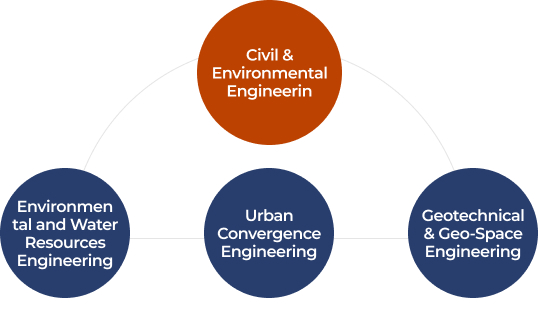
Introduction to UST-KICT School KICT School originally started as part of the UST campus in 2004, and was elevated to the status of a school in the field of construction to replace the UST KICT campus in March of 2017. The goal of KICT School is to educate talented convergence specialists in construction research through its professional and advanced education system. To accomplish this, KICT School is running one convergence major called Civil & Environmental Engineering and three sub majors. Its unique education system is
completed with the help of excellent researchers in a government-funded research institute which leads Korea’s construction research and has cutting-edge research facilities and infrastructures. Students of KICT School have the opportunity to participate in actual R&D projects. They receive firsthand experience at real industrial sites, and undergo research-oriented education and training in their respective disciplines. 
Programs and Majors at KICT School
-
Civil & Environmental Engineering
-

-
The Civil & Environmental Engineering program aims to foster professionals that have integrational capacity of cutting-edge technology for future urban construction and environmental technology as solutions to urban problems. To foster integrational solution experts that understand all future construction technologies and are capable of resolving urban problems, this program offers sub majors consisting of construction environment engineering, urban and transportation system engineering, and geotechnical & geo-space engineering.
-
-
Sub MajorEnvironmental and Water Resources Engineering
- All fields of environmental engineering, such as water and wastewater treatment, wastewater treatment, advanced treatment, seawater desalination, etc
- The entire area of water management research, including floods, droughts, rivers, and groundwater
- A Study on the Operation and Real-Scale Field Experiment of Empirical Pilot Plant
-
Sub Major Urban Convergence Engineering
- A Study on the Fundamentals of Smart Cities such as C-ITS, BIM, and Road Facilities
- Learn expertise, such as convergence and integrated research in electrical, information and communications, and chemical fields, etc
-
Sub Major Geotechnical & Geo-Space Engineering
- Fundamental research on geotechnical engineering and studies on related theories
- A Study on Geotechnical Technology in Extreme Conditions and Future Space Conditions such as Moon and Mars
Faculty and Students(Unit: Person, as of March 2026)
Faculty and Students(Unit: Person, as of March 2026)| Sub Major program | Faculty | Students | Total | Remarks | ||
|---|---|---|---|---|---|---|
| Ph.D | Integrated | Master’s | ||||
| Environmental and Water Resources Engineering | 19 | 8 | 6 | 8 | 22 | Local: 30 International: 12 |
| Urban Convergence Engineering | 21 | 4 | 5 | 6 | 15 | |
| Geotechnical & Geo-Space Engineering | 10 | - | - | 5 | 5 | |
| Total | 50 | 12 | 11 | 19 | 42 | |
UST Master’s and PhD student recruitment
-
Selection
- Applications open: PhD programs, integrated programs, Master’s programs, contract programs.
- Rounds: First term (applications open in September, selection in October-November, admitted in March next year).
- Second term (applications open in March, selection in May-July, admitted in September).
-
Contact
- Faculty contact: Choi, June-Seok (031-910-0759, jschoi@kict.re.kr)
- Academic administrators:
Lee, Hyun Suk (031-910-0603, hslee@kict.re.kr)