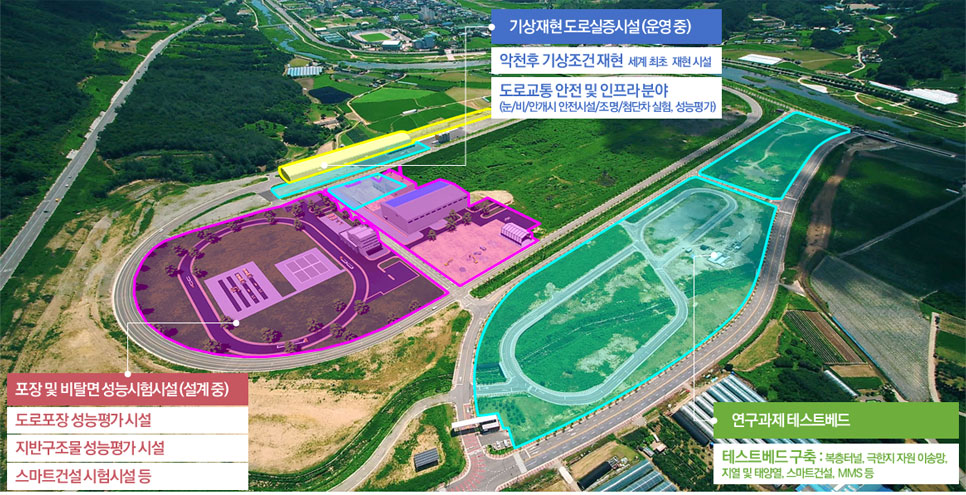
The SOC Demonstration Research Center, which sits on a site of 692,110 m² in Yeoncheon County, Gyeonggi Province in Korea, is the KICT's solution to Korea's technology demonstration research needs.
Designed to be a one-stop testing hub for construction and transportation technology, the SOC Demonstration Research Center consists of facilities for SOC technology testing, integrated business support, and construction and transportation R&D testing.
National Road Infrastructure Performance Testing Facilities (K-Road)
Outline
Located within the SOC Demonstration Research Center, the National Road Infrastructure Performance Testing Facilities (K-Road) are the largest and most advanced of their kind in Korea, fulfilling the original goal of the KICT and the Ministry of Land, Infrastructure and Transport. Simulated climate testing, road testing, accelerated pavement testing, and full-scale road particulate matter reduction testing are some of the notable categories of testing that take place here.
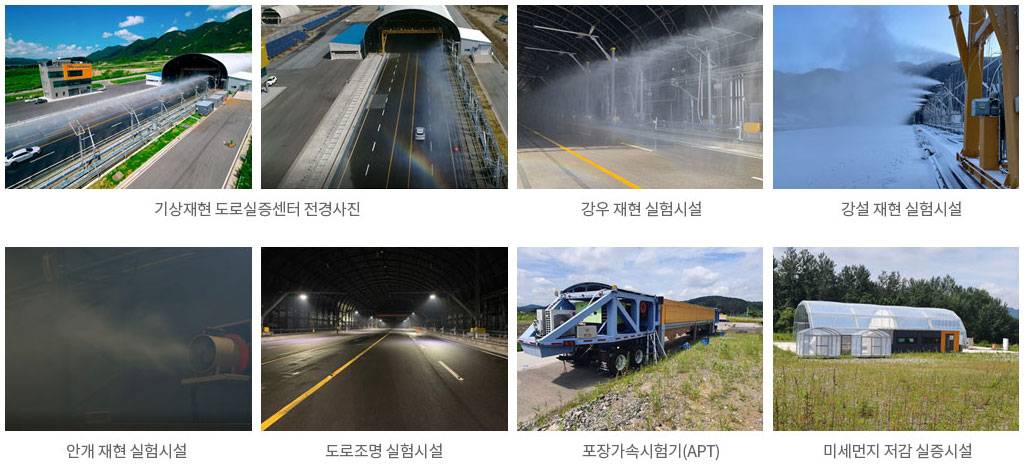
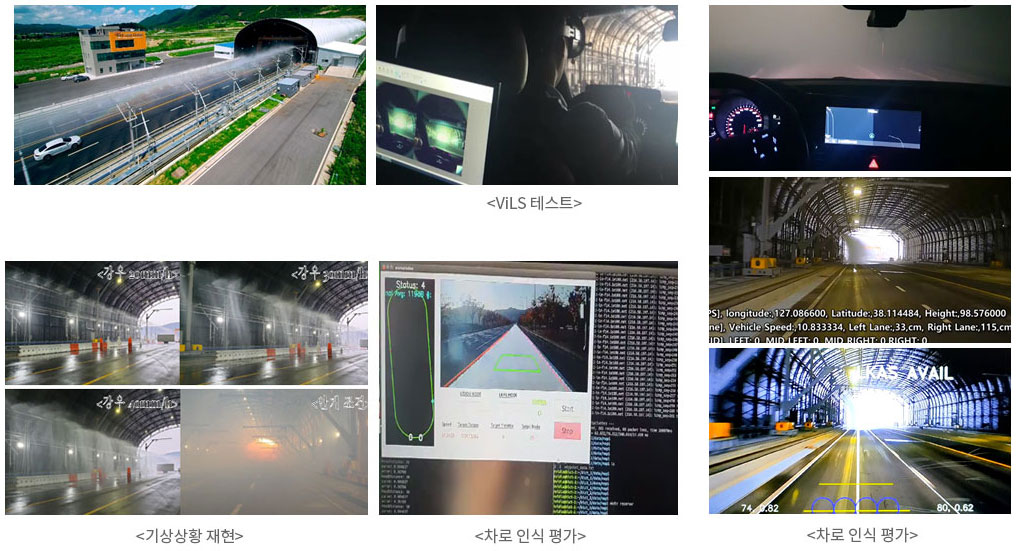
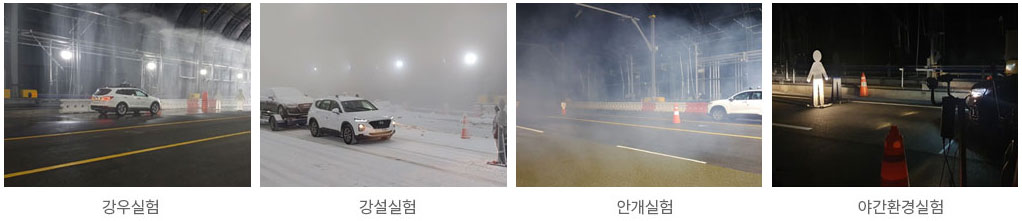
As the nation’s first, weather simulation facilities at K-Road can accurately mimic poor weather conditions, producing fog limiting visual range to 30 m, heavy rainfall of up to 50 mm-100 mm per hour, and heavy snowfall of up to 5 cm per hour. A nighttime environment testing facility featuring track-mounted lighting equipment reproduces nighttime driving conditions. Other testing technologies include road noise, functional pavement, energy harvesting, deicing, mobile gantries (used in road signs testing), and tunnel-shaped shields (which reproduce foggy/tunnel conditions).
Simulated road testing technologies reproduce poor weather conditions in which the baseline safety function of road visibility enhancement features such as lighting, delineators, and visual management systems is verified, and the ability of advanced driver assistance systems (ADAS) and self-driving cars to sense lanes and objects is tested. Accelerated pavement testing enables durability testing of pavement in a short period of time as needed when testing new paving techniques or road surface marking clarity. Full-scale road particulate matter reduction testing verifies the effectiveness of particulate matter control technology.
K-Road enables advanced road and mobility technology to become developed, verified, and enter the market. As a valuable asset to the Korean government’s "K-New Deal" initiative, expansion of the road transportation industry of Korea being one of its focus areas, K-Road is the birthplace of cutting-edge Korean road and mobility technology.
Simulated Climate and Road Testing Facilities
Notable Achievements in Research and Testing
Major Experiments
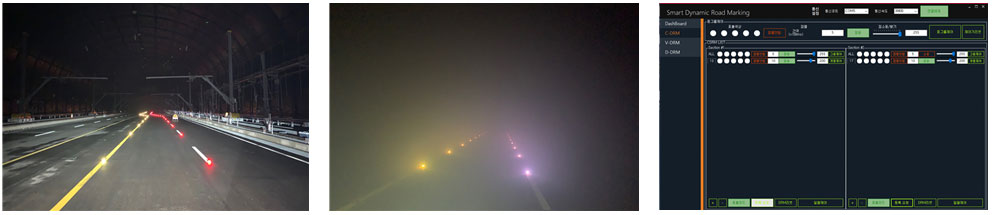
Smart Road (Dynamic Road Marking) Technology
Better guidance of vehicle movement in areas where a quick lane change is required (construction zones)
Bluetooth low energy (BLE) for conveyance of road event information (construction zones, accidents, etc.) to driver
Brightness and color control of DRM units in small groups (5 to 10) and in medium groups (20 to 50)
Testing for optimum DRM luminosity
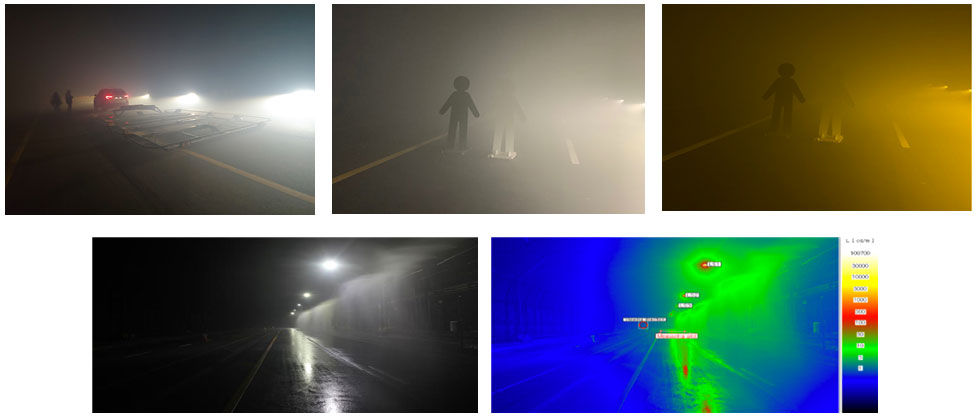
Smart Road Technology Assessment: Road lighting in poor weather conditions
Dramatic improvement in visibility in poor weather conditions relative to lights on poles
Diffuse reflection minimization in the rain for improved lane visibility
Fog-activated color temperature for improved lane visibility
Light lines enable safe driving with an improved driving feel in poor weather conditions
Smart Road Technology Assessment: Verifying the functional limits of variable speed limit signs in poor weather conditions
Unique values measured to calculate correlations between optical characteristics and visual range
Impact of VSL sign size and brightness on visual range in the fog measured
Minimum brightness of roadside information facilities (LED signs) in poor weather conditions determined
Technical standards can be set for brightness of information facilities conveying road event information and speed control instructions in conjunction with DRM
Smart Road Technology Assessment: Visibility of automobile tail lights in poor weather conditions
Reduced function of four types of mass-produced tail lights in the fog was assessed
At varying levels of brightness, tail light visibility was measured, and driver utility and brightness-to-visibility ratio were assessed
Reduction in visibility of tail lights in the fog vs. clear atmosphere was verified
Minimum brightness of tail lights needs to be standardized for road user safety
A variable brightness technology applicable to tail lights for better visibility in poor weather conditions (especially the fog) is needed
Patent pending: Automatic brightness adjustment of automobile rear combination lamps (tail lights + brake lights) in response to changes in visual range