No more carbon emissions! The era of Carbon dioxide-eating concrete is here!
- Evelopment of carbon dioxide-storing concrete technology utilizing CO2 nanobubble mixing water
- CO2storage capacity of 1.0ᅳ1.8 kg per 1 ㎥ ready-mixed concrete
The Korea Institute of Civil Engineering and Building Technology (KICT) has become the first Korean organization to develop "Carbon Eating Concrete (CEC) using Nanobubbles," a groundbreaking technology that stores carbon dioxide (CO2)—a major contributor to global warming—within concrete using nano-bubbles.
Concrete is the most widely used artificial material worldwide, with an annual production volume of approximately 30 billion tons. As demand for urbanization and infrastructure grows, so does concrete usage. Despite being a single material, the process of concrete production (including cement manufacturing) accounts for about 5% of global greenhouse gas emissions due to the significant CO2 emissions involved. "Carbon Capture Utilization for Concrete (CCU Concrete)" technology is concrete produced by utilizing CO2 in a manner that does not impact climate change. In a paper published in Nature Communications in 2021, it was estimated that CCU concrete could theoretically sequester 0.1ᅳ1.4 Gt of CO2 by 2050. CCU concrete is recognized as the only technology capable of mineralizing captured CO2 through reaction with concrete, thereby storing CO2 stably inside the material without re-releasing it into the atmosphere.
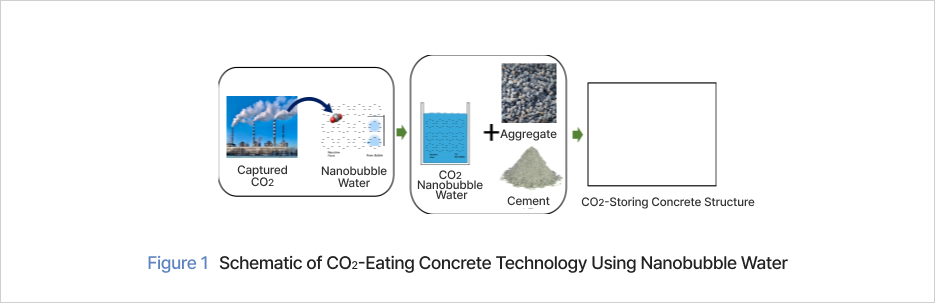
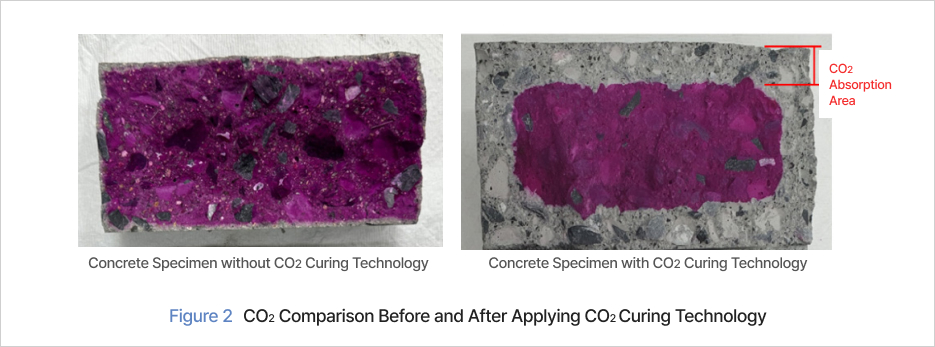
Typically, concrete undergoes carbonation when exposed to atmospheric CO2 lowering its internal pH and losing alkalinity. While atmospheric CO2 concentration is very low at 400 ppm, causing this carbonation process to proceed extremely slowly, it puts the reinforcing steel surrounded by low-durability concrete at an increased risk of corrosion. However, CCU concrete technology intentionally induces a reaction between high-concentration CO2 and the internal concrete materials. Through this chemical reaction, the CO2 is converted into carbonate minerals that enhance strength, permanently storing it within the concrete. Consequently, these carbonate minerals increase the microstructural density, enabling the production of concrete with improved strength and durability compared to conventional concrete. In other words, CCU concrete is not merely a CO2 storage solution but offers additional benefits like enhanced concrete performance and reduced cement usage, indicating significant market potential. The research team at the Department of Structural Engineering Research of the KICT has thus developed the first "Carbon Eating Concrete (CEC)" in Korea, which can effectively absorb and store carbon dioxide in concrete structures while simultaneously improving concrete's compressive strength and durability using nanobubbles.
Concrete is traditionally manufactured by mixing cement powder, water, and aggregate. The research team developed CO2 nanobubble water, which is capable of storing high-concentration CO2 even under standard atmospheric conditions. "CO2 nanobubble water" is water containing numerous nanobubbles with high CO2 dissolution. The developed technology utilizes CO2 nanobubble water and industrial by-products in concrete production instead of regular mixing water. Advanced analytical techniques (Raman spectroscopy) verified the chemical interaction between CO2 in nanobubble water and concrete.
The developed technology allows the direct storage of 1.0-1.8 kg of CO2 per 1 m³ of concrete production, comparable to the CO2 storage volume achieved by "Carbon Cure," a world-leading direct injection technology company from Canada. In addition, the research team developed "CEC" by applying optimal temperature and humidity conditions and mixing techniques using high CO2-reactivity industrial by-products to reduce cement usage. The developed CO2curing technology can maximize concrete's physical performance while minimizing the amount of cement required. Compared to traditional steam curing, it consumes less energy during production and achieves equivalent or superior compressive strength through CO2 curing techniques. A significant advantage is its high CO2 storage efficiency. To simulate CO2 curing environments under various temperature and pressure conditions, the team established Korea's largest high-temperature, high-pressure CO2 curing system for concrete. This achievement was developed through the major KICT project "Development of Eco-Friendly Carbon Eating Concrete (CEC) Manufacturing and Utilization Technology (2022ᅳ2024)," supported by the Ministry of Science and ICT.