Development of 3D Printing Materials for the Automation of Underwater Construction
Development of 3D Printing Materials for the Automation of Underwater Construction
▲ Research Specialist Seoh Eun-a and Senior Researcher Lee Ho-jae, Department of Structural Engineering Research, KICT
Prologue
In 2024, the World Meteorological Organization (WMO) announced through its "State of the Global Climate 2023" that global sea levels have been rising at a rate of 4.77 mm annually over the past decade, more than twice as fast as previous periods, while average sea surface temperatures reached record highs. With 40% of the world's population living within 100 km of coastlines, these rising sea levels mean that people are facing immediate challenges in securing living spaces and survival. As the need to secure marine resources and expand living areas increases, demand for coastal spaces is growing, with development expanding into underwater spaces. In Guam, Dubai, and the Maldives, underwater hotels and resorts have been built at depths of 5-6 meters, and are currently operational.
In Korea, Hyundai E&C and the Korea Institute of Ocean Science & Technology (KIOST) have formed a consortium to build an underwater science base in the sea off Ulju-gun, Ulsan, with completion targeted for 2026. Furthermore, the development of new underwater construction technologies is expected to increase the construction of facilities for rapid recovery from natural disasters such as typhoons and earthquakes, which are becoming intensified by abnormal climate conditions, as well as preventive facilities from a disaster prevention perspective. Although demand for underwater structures is increasing, practical difficulties exist in the construction and quality control of underwater projects. In particular, the underwater construction field faces increasing safety risks due to a shortage of divers and the aging of the existing diver work force, creating a growing demand for underwater construction automation technologies. There is also an increasing demand for automation technologies for the repair and reinforcement of various underwater structures, such as water intake and discharge structures, dams, and underwater portions of bridges. When constructing underwater structures, high-performance structural and material technologies that can withstand water pressure are essential, and there also are challenges related to weather conditions. To overcome these environmental challenges, the application of technologies that minimize diver deployment through the use of underwater robots is expanding. Underwater robots can work even in strong currents, solve problems that are difficult for humans to address underwater, and improve the accuracy of construction through real-time filming and sensing technologies.
KIOST opened the Underwater Construction Robotics R&D Center in 2013 in response to social demands for underwater construction automation. This R&D Center developed robotic technologies for six years until 2019, and pursued demonstration and dissemination projects for four years until 2022. In particular, the Underwater Construction Robotics R&D Center developed three types of robots: a light-duty swimming ROV (Remotely Operated Vehicle), a heavy-duty swimming ROV, and a track-based robot for underwater welding, subsea cable burial, underwater structure installation, and pipeline burial work. Due to the absence of on-site construction technology for underwater structures, 3D printing technology for underwater construction emerged as an automation solution to address this technical gap, as construction 3D printing technology is known to be applicable in extreme environments like space habitat creation. With recent global initiatives for underwater city development and the construction of offshore structures connected to underwater environments, research on underwater construction 3D printing technology is expanding worldwide. This article briefly discusses the current status and direction of development of 3D printing materials for underwater construction automation.
Required Performance of 3D Printing Materials for Underwater Construction
Concrete is a material that requires sufficient flowability to fill formwork properly. However, materials for 3D printing need to have the opposite characteristics—they must maintain their shape after extrusion, and resist deformation from external forces as they are continuously stacked. Generally, construction 3D printing technology consists of three stages: production, pumping, and printing. Since cementitious materials decrease in flowability and harden over time, material development must be aligned with the entire system, from production to printing. If materials harden too quickly, blockages can occur inside the equipment; on the other hand, if flowability decreases too slowly, the materials will not stack properly. Because cementitious materials are difficult to control even with subtle changes in raw materials and are sensitive to temperature and humidity changes, the development and property control of construction 3D printing materials is the most difficult and critical technology.
Concrete is a mixture of cement, water, sand, and gravel, taking at least 8 hours to harden after mixing. Since components can be washed away when in contact with water before hardening, placing concrete underwater presents technical challenges. For underwater construction 3D printing materials, printability, stackability, dimensional stability, and dynamic performance are key. The transportation and printing performance of 3D printing materials can be quantified through flowability and rheology evaluation, and the application of undersegregation water anti-cementitious materials is essential. Generally, to ensure layer stackability and dimensional stability, a method of adjusting the nozzle movement speed (stacking speed) according to the stacking path is used.
Most construction 3D printing materials use mortar, a mixture of water, cementitious materials, and fine aggregates. For 3D printing technology to be practically usable, faster printing speeds than current mortar 3D printing technology are required, as mortar 3D printing has limitations when it comes to improving the one-time printing area of a layer. However, 3D printing materials mixed with coarse aggregates have an advantage in that the coarse aggregates within the layers provide support and friction, making it easier to increase layer height. Accordingly, research on technologies applying coarse aggregates to aerial and underwater 3D printing for construction has been expanding globally since 2020.
Performance Verification of 3D Printing Technology for Underwater Construction
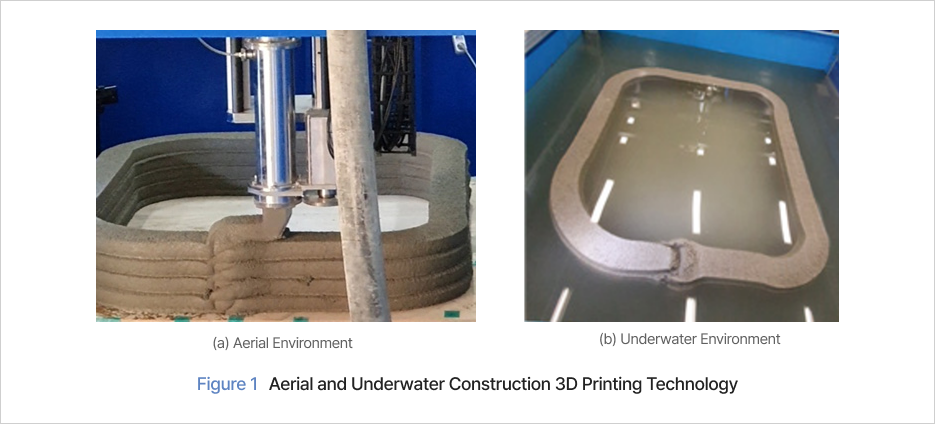
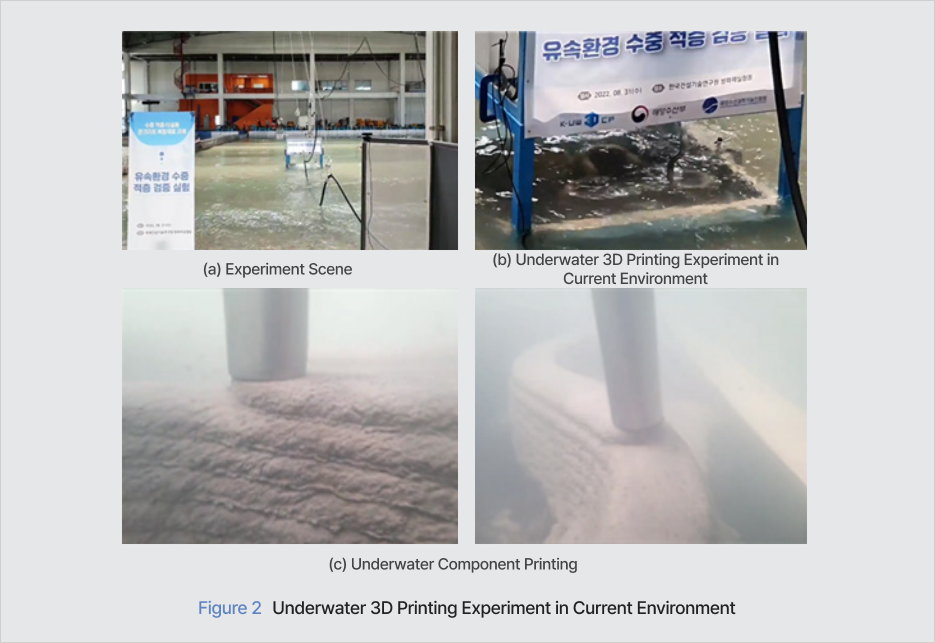
From 2020 to 2022, the Korea Institute of Civil Engineering and Building Technology (KICT) conducted research on "Development of Concrete Composite Materials for Underwater Stacked Placement." Through this research, concrete composite materials with an underwater stacked compressive strength of 30 MPa or more and an underwater/aerial compressive strength ratio of 80% were developed, along with underwater concrete stacking experimental equipment capable of achieving a single layer height of 50 mm and a layer width of 100 mm. The developed underwater construction 3D printing technology underwent performance verification experiments in a large water tank and at the KICT's breakwater testing facility. Concrete specimens were produced under identical conditions in both underwater and aerial environments using the developed underwater construction 3D printing technology, and layer width and height, total height of the stacked structure, and compressive strength were measured. In a static water tank environment, the underwater stacked concrete achieved a compressive strength of 62.8 MPa, which was 99% of the aerial compressive strength. The underwater printed components had a layer width of over 100 mm, a stacking thickness of 52.9 mm, and a deflection relative to the total height of the component of only 1 mm, demonstrating high dimensional stability (Figure 1). In addition, the performance of the underwater 3D printing material was evaluated under conditions simulating the average flow velocity of Busan New Port at the KICT's breakwater testing facility. During the printing stage, there was minimal separation of the 3D printing material, which maintained its shape during printing and achieved the target turbidity standard of 50 mg/l (Figure 2). Through these tests, it was confirmed that direct construction of structures using 3D printing technology is possible in underwater and current environments.
Epilogue
Underwater construction 3D printing technology is poised to become a key proprietary technology in the evolving field of construction convergence, with potential applications in extreme underwater environments like underwater cities and deep-sea bases. However, before it can be widely implemented in underwater construction projects, several practical challenges must be addressed. Currently, the technology shows promise in several areas, including creating artificial reefs tailored to support the growth of seaweed and shellfish, manufacturing custom replacement parts for damaged underwater structures, and building underwater structures to prevent coastal erosion. Furthermore, the development of repair and reinforcement technologies could lead to automation in underwater structure maintenance. With continued advancements, underwater 3D printing technology is expected to play a significant role in the repair and construction of underwater structures, opening the door to more efficient and scalable solutions in the field.
References
- World Meteorological Organization (2024) State of the Global Climate 2023, 1347, 3-7.
- Korea Institute of Marine Science & Technology Promotion (KIMST) under the Ministry of Oceans and Fisheries (2023), Final Report on the Development of Concrete Composite Materials for Underwater Stacked Placement