Introducing Robots into Residential Spaces: Research on Human–Robot Interactive Architectural Technologies
Research Specialist Yang Hyeon-jeong, Department of Building Research, KICT
Prologue
In recent years, robotic technologies have advanced rapidly through the convergence of physical computing and generative AI, along with significant progress in humanoid robot development. As a result, the roles and application domains of robots are expanding far beyond their traditional function of simple automation, toward more sophisticated forms of interaction with humans. Robots, once primarily deployed in industrial manufacturing settings, are now evolving into service robots capable of actively responding to a wide range of situations in everyday life. This shift represents not only an inevitable trajectory of technological evolution, but also a direction that aligns closely with emerging social needs and expectations.
Notably, these technological advances have captured attention as promising solutions that address the demographic shifts associated with an aging society. Considering a range of social challenges—including shortages in caregiving personnel, the need to support independent living among older adults, and issues of emotional isolation—robots have the potential to serve not merely as assistive tools, but as meaningful partners in daily life. For example, humanoid robots capable of understanding and responding to human language and emotions hold significant potential to support both the physical and psychological well-being of older adults.
In this context, residential spaces constitute a core environment in which robots interact most closely with humans. Beyond serving a purely residential function, this shift calls for a transformation in architectural technologies and spatial design premised on Human–Robot Interaction (HRI). Against this backdrop, the present study investigates Human–Robot Interactive architectural technologies that support the seamless operation of robots and user-centered interaction within residential environments. Through this research, the study aims to propose a new residential paradigm that enhances quality of life for occupants.
Overview of Research on Human–Robot-Interactive Architectural Technologies
Research on Human–Robot-Interactive architectural technologies recognizes the need to move beyond isolated instances of human–robot interaction and toward the development of integrated cooperative systems that combine humans, robots, buildings, and spaces. The ultimate goal of this research is to develop human-centered, robot-interactive architectural technologies—integrating architectural space and services—to enable meaningful and effective interaction between humans and robots.
More specifically, the study seeks to propose spatial adaptation strategies that allow robots to effectively support humans through research on dynamic interactions among robots, spaces, and occupants. In parallel, it aims to develop technologies for real-time data analysis and spatial optimization by linking robots with smart building infrastructure.
The research is conducted in a phased manner over a three-year period. In the first year, the focus is on establishing the foundational framework for the development of robot-friendly interactive architectural technologies. Based on a survey of robot technologies applicable to architectural spaces, robots suitable for deployment in residential environments are selected, and a Human–Robot Interactive operational environment is constructed.
In the second year, the research advances to the development of multimodal data utilization technologies for interactive robot-use environments, the establishment of user-tailored response optimization technologies, and the development of prototype control services integrated with existing Robot Operating System (ROS)-based platforms.
In the third year, user-tailored services are validated in real-world usage environments, interactions between architectural spaces and robots are optimized, and the connectivity and integration among humans, buildings, and robots are comprehensively verified. This research is conducted at the “Interactive Smart Housing Laboratory” located on the 5th floor of Building 8 at the KICT headquarters, where existing smart home functions are expanded to realize an interaction-driven technological environment and architectural space improvements that support the evolution toward Human–Robot–Building interactive environments.
Trend Analysis of Care Robots and Service Models
To support the introduction of robot services in residential environments, a review of domestic and international trends was conducted, focusing on robots that are commercially available. In Korea, robots such as Hyodol—used for health management, emotional interaction, and emergency assistance—and Pibo, which provides senior care and childcare services, are being applied in caregiving contexts. In the United States, robots such as Stretch (a mobile manipulator for home use) and Moxi (used for medical supply delivery and laboratory sample transport) have been introduced in healthcare and caregiving facilities. In Japan, emotionally interactive robots such as Paro (a robot with the appearance of a seal), Lovot, and Pepper are being utilized for dementia and depression management, reflecting the active adoption of companion and social robots. Overall, however, the diversity of service robots remains limited, and the number of commercially available platforms is still relatively small.
To guide the selection of robots for deployment, the study examined the types of services required in residential settings. The Korean government’s “Senior Residence Activation Plan,” announced in July 2024, outlines service needs across three stages of aging. In the “Independent Living Stage”, support is required for daily living activities such as household chores and meals, leisure activities, and regular well-being check-ins. In the “Care-Required Stage,” services such as customized elderly care, home-based nursing care, safe housing, and healthcare support are needed. In the “Specialized Care Stage,” residential living and long-term care support in senior care facilities are deemed essential. Based on this framework, the present study focuses on exploring how robots can provide the services required by older adults in the “Care-Required Stage,” with the aim of supporting daily living and caregiving needs within residential environments.
Selection and Technical Analysis of Robots for Residential Deployment
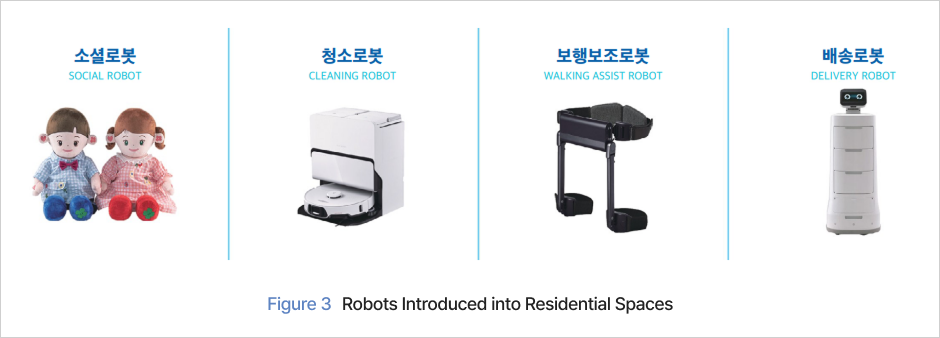
To develop service scenarios for elderly care robots in smart housing environments, three commercially available robots were selected for this study. LG CLOi (Delivery Robot) provides food and beverage delivery, mail and essential item transport, and user-tailored environmental services. Roborock (Household Robot) is equipped with spatial mapping and navigation functions to deliver automated indoor cleaning services. Hyodori (Social Robot) applies Internet of Things (IoT) technologies to provide 24-hour monitoring of older adults’ daily activities, emotional states, and safety conditions.
These robots are managed in an integrated manner through the Home Assistant platform, a system designed to implement diverse residential management services using APIs linked to each robot’s respective control platform. The interactive environment has been developed as an open system so that it can be readily expanded to accommodate the future deployment of humanoid robots.
The content was organized based on role-based robot scenarios in smart housing environments. A smart housing service scenario was developed using the daily routine of a 67-year-old resident (Ms. Kim) as a model. By analyzing her weekday life patterns from morning to night and matching appropriate robot technologies, five core technology domains were identified: mobility assistance robot technologies (fall prevention, route guidance, and object carrying); household assistance robot technologies (automation of cooking, laundry, cleaning, and dishwashing); interactive robot technologies (speech recognition, emotional feedback, and visual and auditory assistance); smart environment integration technologies (control of curtains, lighting, and home appliances); and health and daily-life monitoring technologies (sleep monitoring, fall detection, and temperature and humidity sensing).
Research on Robot-Friendly Residential Spaces
To examine the potential spatial transformations of housing premised on the introduction of robots, this study conducted an analysis of the robot-friendly building certification system. At present, this certification system is primarily operated for general (non-residential) buildings in which robot utilization is more active, and its application to residential spaces remains at an early stage. A representative example is Naver’s Second Headquarters, Korea’s and the world’s first ‘robot-friendly’ building. In April 2022, this building achieved the highest rating under the robot-friendly building certification system by satisfying all 25 evaluation criteria across four categories: △architectural and facility design, △network and system infrastructure, △building operation and management, and △robot support and related services.
Key features of the building include the world’s first robot-dedicated elevators, which enable seamless vertical movement of robots; a wide range of services based on 5G brainless robot technologies; and a multi-robot intelligence system supported by Naver Cloud and the 5G network infrastructure. Approximately 100 “Rookie” delivery robots are currently in operation, performing various tasks, including fire evacuation response.
Based on this certification framework and case analysis, the present study identified essential spatial elements required for deploying care robots in residential environments. Particularly notable elements include: △circulation corridors with a minimum effective width of 1.2 m or more, considering bidirectional movement between users and mobile service robots; △ floor finishing materials suitable for robot mobility (with a coefficient of slip resistance (C.S.R.) of 0.4 or higher); and △ the establishment of an integrated network infrastructure to support IoT and sensor technologies. These elements are expected to serve as core criteria for the future introduction of robots into residential spaces.
Plan for Establishing an Interactive Environment and Collecting Data
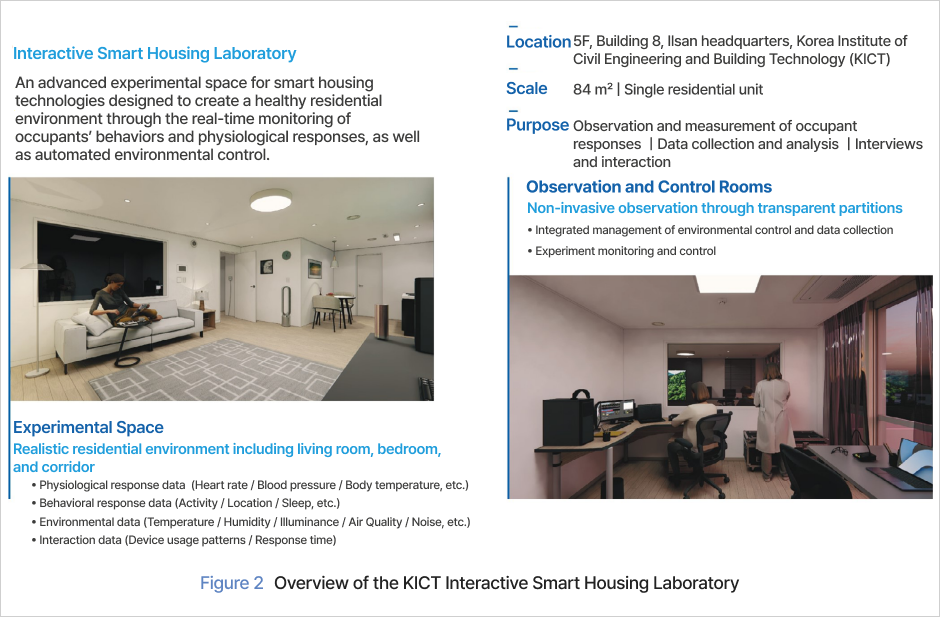
An “Interactive Smart Housing Laboratory”, with a total floor area of 84 m², has been established on the fifth floor of Building 8 at the headquarters of the Korea Institute of Civil Engineering and Building Technology (KICT) in Ilsan. This facility was created as an integrated experimental space for the development of automated, environment-controlled smart home technologies that enable the real-time monitoring of occupants’ behavioral and physiological responses and support the creation of healthy residential environments.
At present, the laboratory is being expanded beyond conventional smart home functions, with the aim of evolving into an interactive environment that facilitates dynamic interactions among humans, robots, and buildings. To achieve this goal, the development of interaction-based technological infrastructure and improvements to architectural spaces are being pursued in parallel.
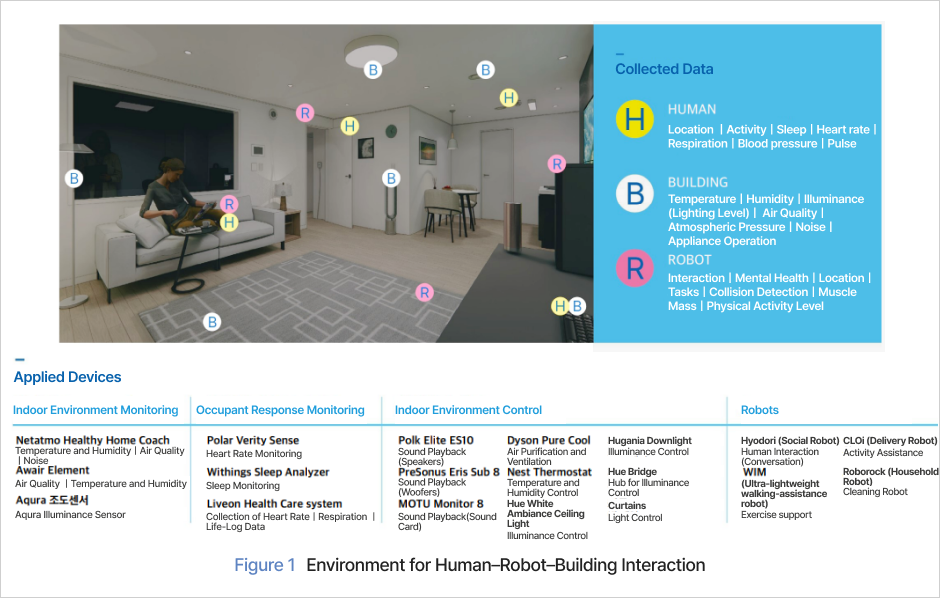
As illustrated in Figure 4, the system is designed to comprehensively monitor and analyze human factors (user location, activity level, sleep status, heart rate, respiration rate, blood pressure, and pulse), building factors (temperature, humidity, illuminance, air quality, atmospheric pressure, noise levels, and appliance operation status), and robot factors (user–robot interactions, mental-health-related responses, location tracking, collision detection, task execution data, muscle mass, and physical activity levels).
In addition, through integration with the smart building infrastructure installed within the laboratory, the system is designed to enable real-time data analysis and bidirectional interactions among all components. This integrated framework is expected to support not only the provision of human-centered, personalized residential environments, but also future expansion toward integrated operation technologies for care robots and the development of data-driven environmental control algorithms.
Epilogue
This study is significant as it represents one of the first systematic efforts to explore the potential introduction of diverse service robots into the everyday setting of residential spaces, along with the architectural transformations and interactive environments required to accommodate them. While the research does not primarily aim to advance robot technologies themselves, it provides an architectural examination of the physical conditions and interaction frameworks necessary for the practical deployment of robots in residential environments. In doing so, the study establishes an important starting point for enhancing the real-world applicability and value of service robots.
Looking ahead, the spatial response strategies and technology integration concepts proposed in this study can be extended toward the development of sustainable residential models that address the challenges of an aging society, improve quality of life, and diversify residential services. Furthermore, it is hoped that this work will serve as a practical foundation for exploring new possibilities in the convergence of architecture and robotics, contributing to actionable pathways for meaningful human–robot coexistence.
References
- Lee, K., Koo, H. M., Lee, Y.S., Jung, M. S., Yoon, D. K., & Kim, K. S. (2022). Development of Robot-Friendly Building Certification Indicators: Application of Focus Group Interviews (FGI) and the Analytic Hierarchy Process (AHP). Journal of Cadastre & Land Information (JCLI), 52(2), 17–34.
- Electronics and Telecommunications Research Institute (ETRI). (2022). Development of Real-Environment Human-Care Robot Technologies in Response to an Aging Society. Report commissioned by the Ministry of Science and ICT.
- Architecture & Urban Research Institute. (2024). Development of Core Technologies for the Design and Remodeling of Robot-Friendly Buildings. Report commissioned by the Ministry of Land, Infrastructure and Transport.
- Ivanov, Stanislav Hristov, and Craig Webster. (2017). Designing robot-friendly hospitality facilities. Proceedings of the scientific conference Tourism. Innovations. Strategies.
- Sheridan, T. B. (2016). Human–robot interaction: status and challenges. Human factors, 58(4), 525-532.
- Sartorius, Marie P., and Petra von Both(2022) “RuleBased Design for the Integration of Humanoid Assistance Robotics into the Living Environment of Senior Citizens.” Legal Depot D/2022/14982/02 : 367.