Current Status and Outlook of Intelligent Transport Systems (ITS) Implementation in Korea
Current Status and Outlook of Intelligent Transport Systems (ITS) Implementation in Korea
▲ Senior Researcher Yoon Young-min, Construction Test & Certification Department, KICT
Prologue
Intelligent Transport Systems (ITS), according to Article 2 (Definition) of the National Transport System Efficiency Act, are transportation systems that aim to scientifically advance and automate the operation and management of the transportation system, enhancing both the efficiency and safety of transportation. This is achieved by developing and utilizing advanced transportation technologies, including electronic controls and communication, for vehicles and transport facilities. ITS encompasses a number of service sectors, including traffic management, public transportation, electronic payments, traffic information dissemination, supplementary traffic information provision, intelligent vehicles and roads, and freight transportation. The introduction of ITS is motivated by the growing challenges of traffic congestion and accidents caused by the increasing number of automobiles. Despite continuous efforts to expand existing roads and construct new ones to address these issues, the complexity of diverse traffic environments has created limitations. Consequently, there is a growing emphasis on enhancing efficiency through the advancement of the management and operation methods of existing facilities.
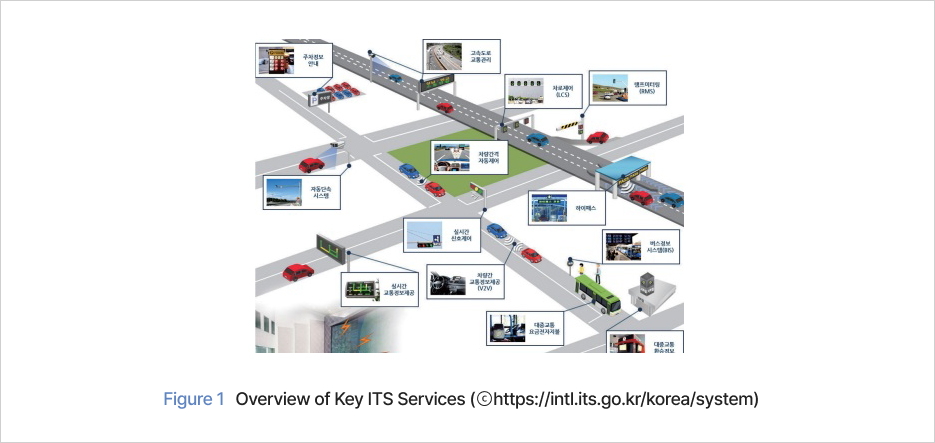

Introduction Stage (1993-2004)
A representative project that marked the initiation of Intelligent Transport Systems (ITS) in Korea was the Freeway Traffic Management System (FTMS), launched in 1994. This system, equipped with CCTV, roadside display boards, and vehicle detection devices on major highways, was implemented to manage traffic flow. It operates through stages of information collection, processing, and dissemination. In 1997, the city of Gwacheon in Gyeonggi Province was designated as an ITS pilot city, leading the way for urban ITS projects. Concurrently, a pilot project for building ITS was initiated on major national roads. Based on these initiatives, Seoul hosted the 5th ITS World Congress in 1998. In 1999, the "Traffic System Efficiency Act" was made law, laying the groundwork for a national, decade-long ITS master plan. In 2001, the Korea Expressway Corporation built the Electronic Toll Collection System (ETCS) pilot project, introducing the Hi-pass automatic toll collection system. By 2003, ITS Model Cities (Jeonju, Daejeon, Jeju) were selected, focusing on cities with World Cup stadiums, to further advance ITS projects.
Growth and Expansion Stage (2005-2012)
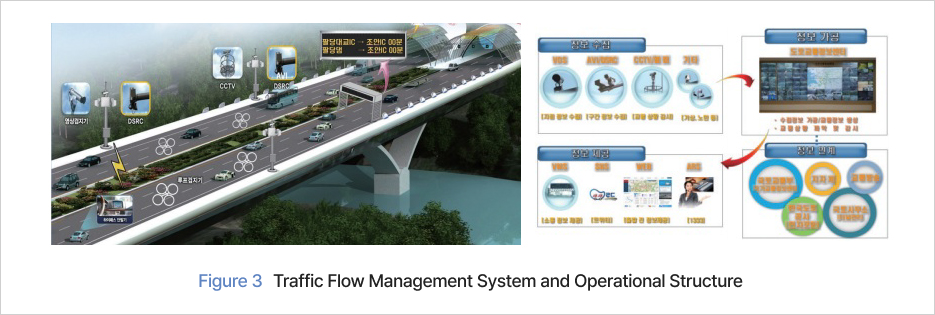
During this period, substantial ITS projects were launched, building on the groundwork and institutionalization established in the introduction stage. In 2005, starting with the Sadang-Suwon section, the Bus Information System (BIS), which aimed at enhancing the convenience of public transportation, was implemented and expanded in metropolitan cities at the local government level. In 2006, ITS centers were established in five local Construction and Management Administrations (Seoul, Wonju, Daejeon, Iksan, Busan) for collecting and providing traffic information on national roads. In 2007, the nationwide implementation of the Hi-pass system on highways was initiated. In 2009, to strengthen the integration of rapidly evolving information and communications technologies with the transportation system, the "Traffic System Efficiency Act" was entirely revised, leading to the enactment of the "National Integrated Traffic System Efficiency Act." This laid the groundwork for the expansion of ITS construction projects across local governments nationwide. In 2010, 12 years after it was hosted in Seoul in 1998, Busan hosted the 17th ITS World Congress, showcasing Korea's ITS technology on the global stage and securing international competitiveness.
Maturity Stage (2013-2022)
In the implementation strategy for "ITS Master Plan 2020," which is a roadmap to the successful implementation plan of ITS projects up to 2020, the most significant change compared to the previous plan (2010) lies in its emphasis on services. Specifically, there has been a shift from the post-incident management of congestion and accidents to proactive prevention. Another noteworthy transformation is the transition of the public sector-led traffic information provision service into a collaborative framework encompassing the public and the private sector.
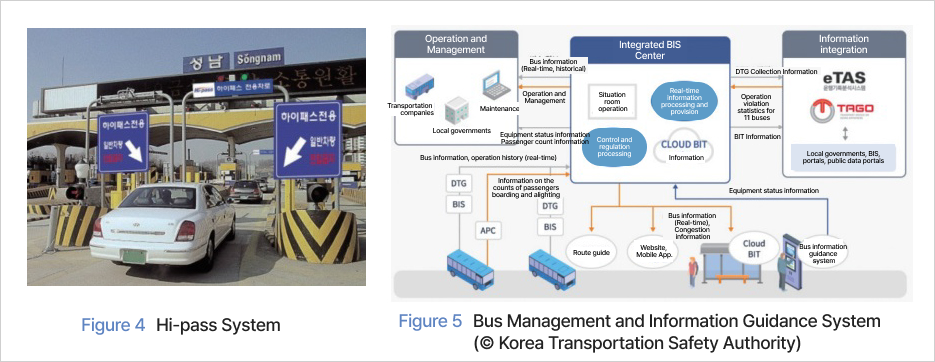
The widespread adoption of advanced IT devices such as smartphones based on 4G (LTE) technology by the private sector led to the generation of real-time traffic information for nationwide roads. As a result, the accessibility of traffic information for service users significantly improved, moving beyond traditional sources like road signs, TV, and radio to smartphone apps. In August 2014, the MOLIT devised an ITS innovation plan that separated the roles of the public and private sectors to maximize the efficiency and effectiveness of investments in collecting and providing transportation and traffic information. Based on this, an MOU on collaboration in transportation information provision was signed between the government and private companies. As result, the installation of communication information collection devices, such as vehicle detectors, was reduced on major highways and national roads, while the deployment of safety information collection equipment, such as emergent situation detection systems, was expanded.
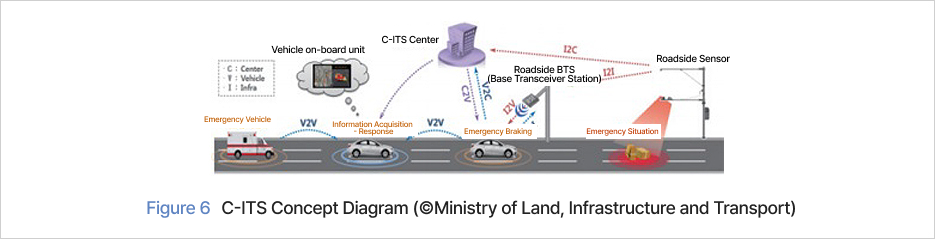
In 2014, the pilot project for the next-generation Intelligent Transport System (Cooperative ITS or C-ITS), incorporating technologies that included Wave communications technology, GPS, precision maps, and security technology, was commenced on sections of highways and national roads between Daejeon and Sejong. Starting in 2018, demonstration projects were implemented in Seoul, Jeju, Ulsan, Gwangju, and other locations. The primary distinction between conventional ITS and C-ITS lies in their communication methods. While ITS employs a simplex communications approach, collecting information at a control center for processing and dissemination, C-ITS utilizes Vehicle-to-Everything (V2X) communications. This full duplex communications approach involves the real-time exchange of information between vehicles and vehicles (V2V), vehicles and pedestrians (V2P), and vehicles and infrastructure (V2I). This enables the proactive sharing of traffic and safety information, allowing for both a preventive and responsive approach to congestion and accidents. C-ITS has evolved as a key technology for ensuring the stability of future autonomous vehicles through autonomous collaborative driving.
Outlook on the Present and Future (2023-2030)
In recent years, several local governments have applied a number of advanced information technologies to various ITS projects, including artificial intelligence (AI), big data, the Internet of Things (IoT), edge computing, and digital twin, through the government subsidiary on ITS projects. Notably, the most actively pursued project in the field of ITS solutions is the Smart Intersection Traffic Management System, which monitors intersection congestion levels in real time, dramatically improving public safety and traffic flow, securing the golden hour for emergency patients, and ensuring the safe operation of emergency vehicles.
In 2025, Suwon is set to host the ITS Asia-Pacific Conference, which will be followed by Gangneung hosting the ITS World Congress in 2026. These events are expected to have diverse practical impact, which will include vitalizing Korea's ITS industry to lead the global mobility market and enhancing the competitiveness of Korean companies in overseas markets. "ITS Master Plan 2030," which maps the future of ITS up to 2030, envisions the realization of a digital road system supporting eco-friendly advanced mobility services. It sets goals in four areas: safety, efficiency, innovation, and convenience. Over the past 30 years, from 1993 to the present, Korea's ITS has grown consistently, adapting to a rapidly changing road and traffic environment and advancements in IT. However, the ITS environment needs to evolve to adapt to a number of changes: social shifts, including the recent ongoing population decline, aging society and increasing number of single-person households, growing leisure time, sluggish economic growth, climate change, and transition to a carbon-neutral era.
―――――――――――――――――
1. This is an annual general meeting of the ITS International Organization, a union of ITS implementation organizations from each country to exchange information and seek development regarding ITS, and a gathering to discuss the current status and case studies of member countries and exchange information on ITS systems and applications, as well as technical, structural, and institutional issues around ITS implementation.
2. Various services and means of transportation, contributing to the convenient movement of people and objects
―――――――――――――――――
Reference
• 2022 Roadwork Manual, Ministry of Land, Infrastructure and Transport
• ITS Master Plan 2010, 2020, 2030, Ministry of Land, Infrastructure and Transport